ABOUT 3D'OMICS

Workflow

In recent years, there has been a rapid development of techniques that, separately, enabled the generation of multiple omics data, including both microbial and host components, processing very small amounts of biological material, generating 3D reconstructions of biological elements, and analysing complex microbial communities. The technology required for 3D multi-omics was therefore in place, enabling us to develop, implement and assess a methodological framework designed to advance animal-microbiota research in animal science and beyond. 

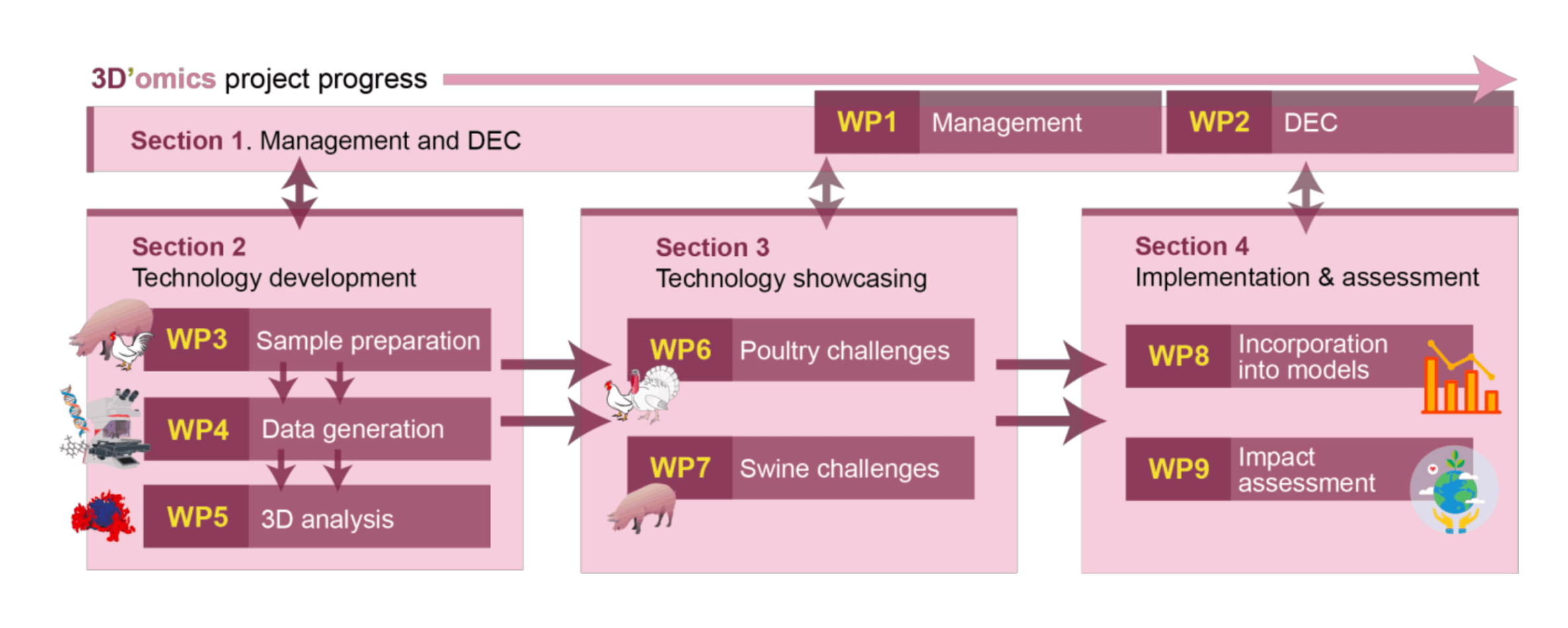
The 3D’omics project was structured in 4 sections encompassing 9 work packages (WP), meticulously designed to achieve its objectives. The project consisted of two structural WPs (Section 1) that were active throughout the entire duration of the project, and seven more WPs clustered in three clearly defined sections: technology development (Section 2), technology showcasing (Section 3), and implementation and assessment (Section 4).

Diagram showing the four sections and nine work packages of the 3D’omics workflow
The project brought its work packages together across management, technology development, technology showcasing, and implementation and assessment.

Section 1 · WP1–2

Management and DEC

WP1: Project Management

Lead: UCPH

Management of the overall progress of the project through efficient scientific, administrative, financial, ethical, and data management. Guaranteed that internal and EU reporting was performed adequately, made certain that the project complied with ethical legislation, and ensured tasks and objectives were fulfilled efficiently within budget and on time.

WP2: Dissemination, Exploitation, and Communication (DEC)

Lead: UCPH

Communication of 3D’omics to relevant stakeholders and the general public, and promotion of new collaborative interactions with international projects to maximise the impact of 3D’omics technology.

Section 2 · WP3–5

Technology development

WP3: Sample Preparation

Lead: UCPH

Development of optimal procedures for sampling, fixating, slicing, and micro-dissecting intestinal sections containing epithelial tissue and microbial communities. Generation of biological samples for the in vitro work in WP6/7, and creation of preliminary evidence for improving designs of trials in WP6/7.

Explore WP3

WP4: Data Generation

Lead: MDC

Development of laboratory protocols and workflows to generate multi-omic data from intestinal microsections from different sample types.

Explore WP4

WP5: Data Analysis and Visualisation

Lead: CRG

Development of the analytical procedures required to generate and visualise the 3D reconstruction models from 3D’omic data, and develop mechanistic and deep learning approaches to understand omic interactions between microbes and animals and predict phenotypic/performance outcomes.

Explore WP5

Section 3 · WP6–7

Technology showcasing

WP6: Poultry Health Challenges

Lead: UVM

Showcasing the 3D’omics technology in addressing production challenges associated with diverse types of pathogens in poultry.

Explore WP6

WP7: Swine Nutritional Challenges

Lead: NMBU

Showcasing the 3D’omics technology in addressing production challenges associated with nutrition in swine.

Explore WP7

Section 4 · WP8–9

Implementation and assessment

WP8: Incorporation into Models

Lead: BGU

Providing guidelines and expectations to implement 3D’omics data in genetic evaluation and phenotypic assessment procedures in industrial breeding and feeding programmes.

Explore WP8

WP9: Technology Impact Assessment

Lead: NMBU

Assessment of the technical, social, and economic impact of the 3D’omics technology.

Explore WP9